
 (RGE) www.rage.co.uk/
(RGE) www.rage.co.uk/
Software development company engaged in the writing
of original software forcomputer games and the conversion
of existing games to new games platforms.
Why we bought the share
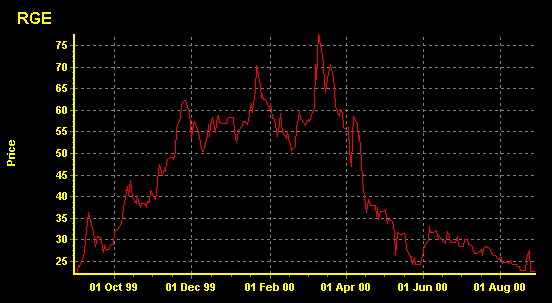
May I propose Rage Software (RGE), currently 28p, as a buy
recomendation for this month. Reasons:
"Shrewd fund managers are hunting out bombed-out computer games
stocks in the hope that the European launch of the Sony Playstation 2
(late October) will send stocks soaring in much the same way as the
launch of the Sega Dreamcast did last year"
Sony has signed more than 150 deals with companies for Playstation
2 to design games for the PS2, Rage being one of them. Below is the
transcript of an interview with the Finance Director earlier this
month.

PETER DESMIER - RAGE SOFTWARE PLC (RGE.L)
CEO Interview - published 8/10/2000
DOCUMENT # KAJ084
Peter Desmier is the Financial Director of Rage Software PLC.
Sector: Entertainment - Services
TWST: You recently reached an agreement with Epic Games, can you
discuss the licensing of their Unreal Engine?
Mr. Desmier: We?ve got the rights to sell that engine in Europe,
for the PC and next generation consoles such as PlayStation II. We
will share a percentage of the proceeds with Epic.
TWST: Perhaps you can explain to our readers what the Unreal
Engine is?
Mr. Desmier: It?s what we call in the business a gun and run
engine. In other words, it sets up the environment for you to be able to
move around in a three dimensional environment, but most specifically,
the feature of this engine is that it?s got a rolling outside
landscape, which not many others have. So in your development, it gives you
the ability to hit the ground running, and you can concentrate more
then on the game play rather than the mechanics of getting things
together.
TWST: This Unreal Engine is so far not licensed in Europe?
Mr. Desmier: Epic have already done a small number of deals with
European developers, although we?re now actively speaking to
developers and publishers over here. Epic themselves will market
that in the States at the moment.
TWST: It will also assist you in developing new products?
Mr. Desmier: Indeed, yes. We bought two of them ourselves.
TWST: Could you discuss your product development at this point?
Mr. Desmier: We?ve got 21 products in development across 10
different studios now, so we?ve grown quite significantly in the last year.
We have plenty of products across all types of genres in development
now.
So it?s quite an exciting lineup.
TWST: You have recently announced a PlayStation II game title that
you will be launching later this year?
Mr. Desmier: Yes. That?s Wild Wild Racing.
TWST: What does it take to create a game for the PlayStation?
Mr. Desmier: Some have an internal scoring progress when they
review work in progress, and we have done much better than their
benchmark product when they have been reviewing our work in
progress, so that is why we are excited about that as one of the
European launch titles.
TWST: When you develop games, is there a specific domain for the
content of your games?
Mr. Desmier: With PlayStation particularly, you are looking at the
sort of 18- to 24-year olds, people who might have had the early 8
bit home computers such as from Commodore or Atari. The age profile
for PCs is a little bit higher. Different types of games sell better
on each of the formats. You?ll have more arcade games selling better
on consoles than PC. You?ll have more strategy, more simulation-type
games on PC. So it depends really on what your game is, how you
pitch the marketing.
TWST: How long does it take, on average, for you to develop a new
game?
Mr. Desmier: A new game? A couple of years now, maybe a little bit
more.
TWST: Can you discuss the acquisition of Caffeine Studios Ltd. and
The Internet Football Club Ltd.?
Mr. Desmier: Yes. We issued a circular to shareholders recently
talking about how we were looking at the future of the entertainment
business, which is what we?re in, and how broadband access is
going to change the way that we look at business. Internet Football Club
was the first acquisition that is part of that strategy in that it is
a browser-based game.
So if you?ve got Internet Explorer or Netscape, you can log on to
The Internet Football Club website and you can play that game for free,
so that?s part of building traffic to the Rage portal.
What we would intend to do with that is to make money from
the advertising, and then build up towards having a sort of ?super
league? and ?specialist cups?, where we can introduce a
subscription element to it. In other words, the customer doesn?t have to pay
for that game.
TWST: In terms of development, is it more complicated to develop
Internet-based games?
Mr. Desmier: I think they have their own particular technicalities
that are specific to network and they are different from other
games, but I would not say that it is any more difficult now - just
different.
TWST: Do you foresee the Internet to be the future in game
development?
Mr. Desmier: I think it is certainly going to play a very big
part. Obviously, traditional products will still be there, but fact is
that Sony are going to have a hard drive attachment to PlayStation II,
and it is likely that X-Box will have a hard drive with it. They are
obviously looking at downloading content over the Internet. So,
yes, that is the way a lot of things will go, and it?s part of our
strategy to take advantage of that.
TWST: Where, roughly, do you foresee the growth factor then to be?
Is it with Internet gaming? Is it working closely with
PlayStation-type products?
Mr. Desmier: Our strategy going forward is to support PlayStation
II; we will support X-Box with another alliance. We will still
continue to develop on PC as the cost of goods is cheaper there, it is a more
friendly business model for publishers. We also see growth from
telephony and set-top boxes for TVs, and also digital content
coming down the wire into your PlayStation II or your X-Box; so broadband
is what we?re waiting for to take advantage of and, indeed, that is
how we are positioning ourselves at the moment.
TWST: Could you elaborate a little bit on new technologies that
are on the horizon and will have an impact on the game industry?
Mr. Desmier: A lot of it is new consoles that are coming out. I
should perhaps mention also Nintendo?s Dolphin and Game Boy advance.
They?re all traditional console and PC-based chips. We?ve obviously got
the Internet, and we?ve got the growth now in what can be offered on
cell phones, and looking really to maybe the third generation to take
the next generation to the one after that.
People are talking about there being more Internet access, more Web
access from sophisticated videophones. Indeed, we have seen some of
those models that are coming out of Japan now, and in some cases they
are more sophisticated than a GameBoy; so there is that market to look at.
We are also seeing new companies entering the games market such as
Nokia, Motorola, Ericsson and Siemens and it is Rage?s intention to forge
relationships and partnerships with all of these people.
TWST: How competitive is the mobile entertainment market?
Mr. Desmier: Strangely enough, a number of the larger publishers
have not really looked at that in too much depth. We?ve been surprised
when we have been talking to the phone companies. They had obviously
approached a number of the larger people, who at the initial stage
were not interested. I think they might find that that was a
mistake, because there are numbers of these phones that are going to be
generated.
TWST: When you speak of telephony, are you talking about Internet
access mobile phones?
Mr. Desmier: In part, yes. The current generation of cell phones
are still very limited in their bandwidth and capabilities, so you?ve
got limited gaming opportunities. However, this is likely to grow
significantly in the coming 12-24 months and a whole host of
opportunities will present themselves, including games embedded
into mobile devices or downloadable via JAVA handsets. We?re
positioning ourselves for this now, as well as the traditional business.
TWST: Geographically, are there specific regions you concentrate
on, given that there might be a language element to games?
Mr. Desmier: Language in the sort of games we are looking at on
the telephone side is not too much of an issue because the games are
fairly simple. They are short development lead time items, which
is another reason why we look at them. It is not particularly risky
to develop a phone game, compared to two years? development
on a PC or a PlayStation. So language isn?t too much of a factor there.
TWST: So, the deal with Epic Games would not effect your presence
in the States?
Mr. Desmier: Not particularly with Epic, no. They look at doing
that themselves in the States. Perhaps if we do a good job for them in
Europe they might review that in 12 months.
TWST: What are the current trends in the sector?
Mr. Desmier: The industry itself is a little flat at the minute
traditionally because it is the end of a product life cycle.
PlayStation I is tailing off now. People are waiting for
PlayStation II. Dreamcast hasn?t been possibly as successful as Sega would
have liked at this stage, where I think it?s still going to hang in
there. So it is at the low point of the cycle - the whole industry - if
you have a look at America, Europe, you will have a number of
companies that are forecasted not particularly good results last year, this
year. PlayStation II will come out towards the end of the year and
you?ll find the life cycle starts to build up again, and you?ll go
for another four or five years? worth of growth.
It?s very cyclical this industry, and investors who do not invest in it
regularly do not necessarily always appreciate that. This stage of the
cycle is a buying opportunity, I think, if you?re not in these sorts of
stocks already. As far as Rage is concerned, we are pretty excited about
the way we are positioning ourselves to take advantage of growth and mobile
telephony, as well as our traditional business, which we?ve geared
up with the increased number of teams for.
TWST: You say that you are at the beginning of a new life cycle,
where do you see your competitive advantage to succeed in that?
Mr. Desmier: Well, I think particularly the strategic advantage is
that we are trying to get for ourselves now with the telephone
people, with products like Internet Football Club and a couple of the
online games that we?re developing, subscription income. I think that
focus has put us a little bit ahead of competition, particularly with
the strategic alliances. The barriers to entry to write a phone game
are not particularly high, but it?s how you get to the market, it?s
the Motorolas, the etc., etc.
TWST: Thank you.
Peter Desmier
Financial Director
Rage Software PLC
Martins Building
Water Street
Liverpool
L2 3SP
United Kingdom
However, Paul reports the following:
Incidentally, todays Daily Mail (25/8/00) carries a financial
warning on Rage Software. Sources claim a profit warning is
imminent and punters who have backed up to as high as 30p from
22.5p in last few weeks may about to get stung. Apparently some
big selling orders went through in last hour of trading yesterday
as dealers "panicked" at thought of impending profit warning. The
author of the article thinks that the rise up to 30p has already
built in hopes that Rage will announce new contracts at the
International Games Fair in London on 3/9/00 including Sony
Playstation2. We could have missed the boat already? - but we
can no doubt debate at next meeting.
STANDING DATA
**************************************
RAGE SOFTWARE PLC
**************************************
Industry: BUSINESS SERVICES
MARTINS BUILDING
WATER STREET
L2 3SP
UK
TEL: (44)151 237 2200
FAX: (44)151 237 2201
Employees: 103
Market Cap (MIL): 60.50M
Officers:
CEO: JOHN D FINNEGAN
CFO: JOHANN LESLEY DAVEY
COB: THOMAS JOHN ROBERTS
Secretary: PETER KENNETH DESMIER